Lorentz Linear Layer
From the Euclidean point-to-hyperplane formulation to the intrinsic Lorentz fully connected layer.
Euclidean linear layer
The standard formulation of a linear layer is $z = Wx + b$. Each output dimension computes one scalar. But there is a geometric property that is used in the hyperbolic generalisation.
Each row $W^{(i)}$ of $W$ defines a hyper plane in the output space:
\[H_i = \{u \in \mathbb{R}^{D_{in}} | w^{(i)\top}u + b_i = 0\}\]The output $z_i = w^{(i)\top}x + b_i$ the signed, scaled distance from $x$ to this hyperplane:
\[z_i = \| w^{(i)}\| \cdot d^{\text{signed}}(x, H_i)\]So, a linear layer with $D_{out} = m$ places $m$ hyperplanes in the $D_{in}$-dimensional input space. The output vector $z \in \mathbb{R}^m$ is the coordinate of $x$ in the system defined by those $m$ boundaries giving one signed distance per hyperplane. The output is a stack of $D_{out}$ signed distances, which forms a new vector in $\mathbb{R}^{D_{out}}$ — a manufactured space whose axes are distances to boundaries.
Example
In this example we pass a random point $x = [1,2]$ trough a linear layer $FC^{2 \times 3}$ without bias.
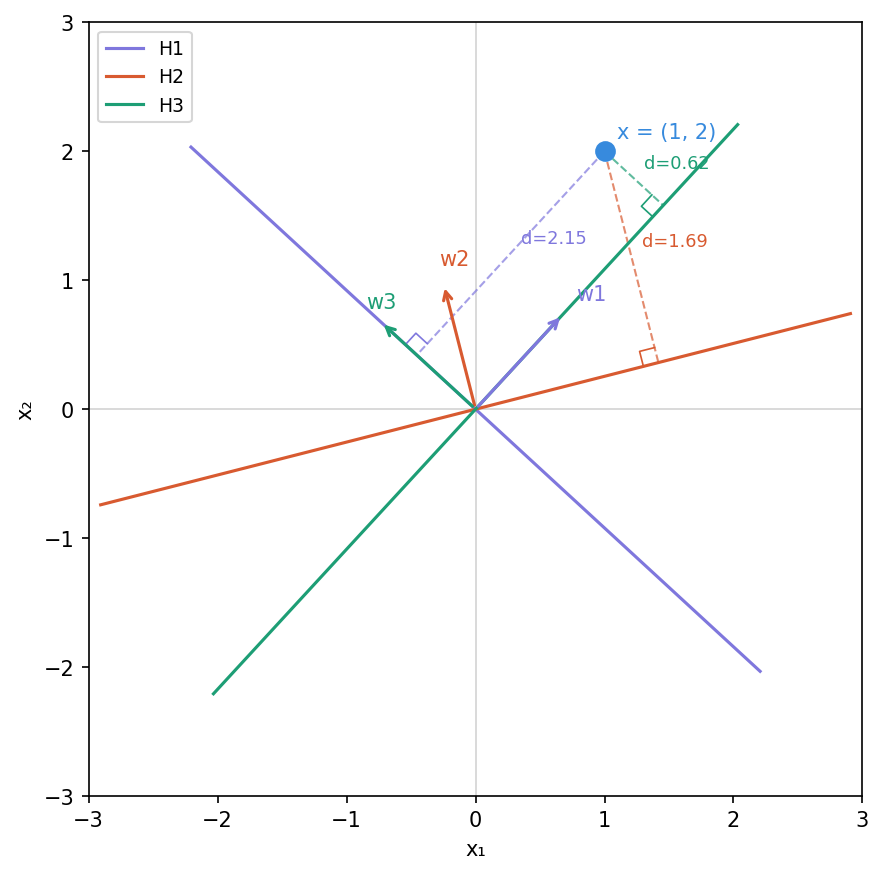
If we were to place multiple layers $D_{in} \rightarrow D_{out} \rightarrow \ldots$, each layer produces a new point in a new space whose coordinates are the distances from the previous layer’s representation to the current layer’s hyperplanes.
Lorentz Model
The $n$-dimensional Lorentz model (hyperboloid model) of hyperbolic space:
\[\mathcal{L}^n_k = \{ x \in \mathbb{R}^{n+1} | \langle x,x\rangle_L = 1/k, x_0 >0 \}\]With the Minkowski inner product:
\[x \circ x = -x_t y_t + x_s^{\top} y_s\]The hyperboloid is a curved surface embedded in flat Minkowski space $\mathbb{R}^{n+1}$.